Hús dagsins
My first web application, rebuilt on our own foundation in 2026
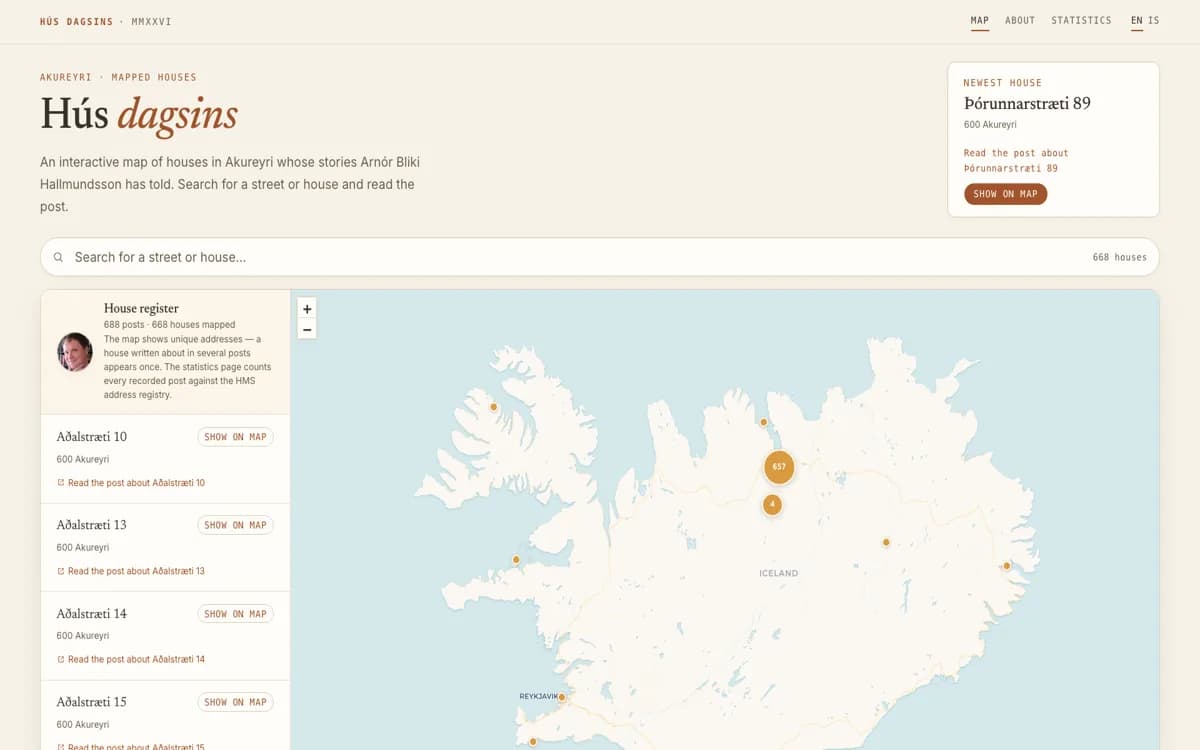
My first web application, rebuilt in 2026: a map of nearly 700 houses in Akureyri and over 750 columns by Arnór Bliki Hallmundsson, on Next.js 16 + Payload on our own infrastructure.
The Challenge
Arnór Bliki Hallmundsson has spent over a decade writing about the historical houses of Akureyri — hundreds of columns documenting the town's architectural heritage. But the articles existed only as text, scattered across blog posts and newspaper columns. There was no way to see the geographic pattern, explore the houses on a map, or understand how the documented buildings relate to each other across the town. I wanted to make that visible — and I wanted to learn how to build for the web.
The Approach
Scraped article data from Arnór Bliki's published columns, geocoded each house location, and built an interactive Leaflet map with searchable pins, smooth zooming, and direct links back to the original articles. Version 2.0 added marker clustering for dense urban areas, a mobile-optimized layout, and a statistics dashboard. The first version ran on GitHub Pages. In 2026 the map was rebuilt on Next.js 16 and Payload with its own database, an editing system and weekly monitoring for new columns.
Outcomes
This is where it started. Hús dagsins is my first web application — an interactive map that brings Arnór Bliki Hallmundsson's decade-long documentation of Akureyri's historical houses into a single, explorable interface.
Arnór Bliki is a teacher at Verkmenntaskólinn in Akureyri and a dedicated local historian. Over eleven years, he has written hundreds of columns about the town's houses — their stories, their builders, their place in Akureyri's history. His work is published on akureyri.net and his personal blog, and he has authored the book Oddeyri. I wanted to give his work a spatial dimension — to let people see the houses on a map, not just read about them.
The Build
The project taught me the entire workflow from data to deployment. I scraped article data from published columns, geocoded each house address to latitude/longitude coordinates, built a responsive map interface with Leaflet, and deployed on GitHub Pages. Three months from zero to a working public application.
Version 2.0 added marker clustering for the dense downtown area, a mobile-optimized layout, and a small statistics dashboard. Each pin links directly to the original article, so the map serves as both a geographic index and a gateway to Arnór Bliki's writing.
The 2026 rebuild
Two years later the map got a new home at husdagsins.sumarhus.com. It now runs on Next.js 16 and Payload on our own infrastructure, in Icelandic and English, and Arnór has his own editor account to add houses and make corrections. The map now counts 753 columns about 697 houses, including all 98 of his blog posts from 2022 to 2026. A weekly agent checks whether a new column has appeared, and a statistics page compares the coverage against the national address registry (HMS).
The look took on Akureyri's colours, the map opens on the whole country, and the newest house comes first.
Why It Matters
Every project after this one — Arctic Tracker, Gjöll, BORG, smarason.is — traces back to what I learned here: that building for the web is within reach, that real data makes better projects than tutorial exercises, and that the best motivation is making something useful for someone whose work you respect.
Technology Stack
People
Lessons Learned
- The best first project is one you actually care about. Mapping a friend's life work made every technical hurdle worth solving.
- Static hosting on GitHub Pages served the first version well. Once the author needed to add and correct entries himself, it was time for a proper editing system.
- Data scraping teaches you more about web architecture than any tutorial. Understanding how content is structured on the web is foundational to building for it.
Related Projects
View all projects →
BORG
The University of Akureyri's hybrid AI platform, combining commercial models with on-premise infrastructure so sensitive data stays on the university network.
Smarason.is
A personal site moved home: Next.js 16 + Payload on its own Hetzner edge with Caddy, no cloud content service, zero tracking. The architecture is the philosophy — sovereignty over your own data.
Institutional Knowledge Graph
Small organisations run on invisible architecture — governance, systems, policies, dependencies that live in people’s heads. This is the complete methodology for making that architecture queryable: Neo4j, JSON-LD, SHACL, and a pipeline that is always safe to re-run.