Beyond Fragmentation
A Life-Value Alternative for AI Governance
Why AI governance fails by design — and why the harms this thesis documents result from institutional choices rather than technological inevitability.
“Technology is of value if and only if it enables a more coherent and inclusive range of thought, feeling, and action.

The Challenge
People are losing agency to systems built in their name. Accountability dissolves across fragmented institutions (Responsibility Fog) while dependence on algorithmic judgment quietly compounds (Cognitive Debt). Meanwhile, capital flows 33 times more toward automating what workers resist than toward what they actually want. The question is not whether to regulate AI, but how to govern for human flourishing instead of symptoms.
The Approach
Grounded in McMurtry's Life-Value Onto-Axiology. The VALOR Framework was developed as a Declaration of Human Agency, mapped onto the EU AI Act, and tested against three production systems (Arctic Tracker, Gjöll, BORG). Structural verification via Neo4j knowledge graph (775 nodes, 411 relationships). 247 citations independently verified.
Outcomes
The Main Argument
The system is not broken. It is working exactly as designed.
The term "governance" is multifaceted and lacks a direct Icelandic equivalent that captures its full scope. While often translated as "management" or "administration," this thesis employs the term governance architecture to encompass the broader framework of rules, ethics, accountability, and systems that shape AI development.
AI governance fails not from a lack of regulation, but through two fundamental mechanisms that systematically degrade human flourishing: Responsibility Fog — the engineered diffusion of accountability across fragmented structures — and Cognitive Debt — the compounding erosion of human judgment through algorithmic dependence.
These mechanisms create an accelerating feedback loop that leads to the Benevolent Cage — a system of total algorithmic care that offers safety and convenience at the price of human agency.
Life-Value Onto-Axiology
The thesis rejects traditional economic approaches, building instead on John McMurtry's Life-Value Onto-Axiology. This concept bridges ontology (what exists) and axiology (what is good). The core premise is that value is not a subjective preference, but an objective requirement for existence:
"X is value if and only if X contributes to a more comprehensive range of thought, feeling, and action."
From this foundation, the thesis proposes the VALOR Framework as a governance alternative mapped onto the EU AI Act (2024).
Core Concepts
Responsibility Fog — Systematic diffusion of accountability through fragmented authority and technical complexity.
Cognitive Debt — The compound costs of outsourcing judgment to algorithmic systems.
The Benevolent Cage — Totalizing algorithmic care that eliminates agency under the guise of protection.
The Investment-Sentiment Gap (ISG)
The Investment-Sentiment Gap is the thesis's core empirical finding, independently verified through the WORKBank public dataset (N=844 tasks, 5,731 worker responses). It quantifies a structural misalignment between where AI capital flows and what workers actually want: 41% of venture capital targets tasks workers actively resist automating, while only 1.26% funds applications workers prioritize — a 33:1 ratio.
WORKBank serves as the foundational data source, but the thesis triangulates this finding across four independent industry reports — the Anthropic Economic Index, McKinsey's State of AI 2025, and the EY/KPMG sentiment indices — confirming the pattern holds across methodologies, geographies, and time periods.
This is not a market inefficiency awaiting correction; temporal analysis shows the pattern is accelerating, with directive AI conversations rising from 27% to 39% between late 2024 and August 2025. The ISG provides measurable evidence for what McMurtry's framework diagnoses theoretically: Money-Sequence logic (M→C→M′) systematically overrides Life-Sequence logic (L→MofL→L′), directing capital toward extraction rather than cultivation.
"Lords do not invest in serf liberation."
The VALOR Framework
Five governance principles framed as a Declaration of Human Agency:
- V — Verification: The right to an unmediated view of reality.
- A — Alignment: The right to define your own goals.
- L — Legitimacy: The right to messy democratic self-governance.
- O — Oversight: The right to hold ultimate authority.
- R — Responsibility: The right to bear consequences.
Validation
Three production systems — Arctic Tracker, Gjöll, and BORG (coming soon) — serve as proof-of-concept for VALOR principles. A Neo4j knowledge graph (775 nodes, 411 relationships) structurally verified the thesis through 39 systematic sweeps.
Interactive sample — 24 of 775 nodes. Hover nodes and edges to explore.
Acknowledgements
Special thanks to my supervisor, Prof. Giorgio Baruchello, for his invaluable guidance and introduction to McMurtry's Life-Value Onto-Axiology. I also extend my deepest gratitude to the external examiner, Dr. Dina Babushkina (University of Twente), and to the thesis committee — Dr. Chris DiCarlo and Dr. Stefán Frímann Jökulsson — for their professional review, encouragement, and honest feedback. Defended January 30, 2026.
Post-Submission Experiments
The Meta-Experiment: Recursive Verification
Following the defense, I conducted a "Meta-Experiment" to test whether the thesis's own principles—specifically Verification and Oversight—could govern the AI generation of the thesis itself. I used GPT-5.2 to simplify the academic text into a "Fun Edition" while simultaneously orchestrating a 6-layer recursive verification system.
The experiment yielded a recursive proof of the VALOR framework:
- Layer 0 (Human): I wrote a Python script (flesch_kincaid.py) to measure the original thesis complexity (Grade 20.6).
- Layer 2 (AI): I used Claude to extend my own verification tools, ironically using AI to build the "police" for the other AI.
- Layer 3 (The Catch): The extended tools caught the AI hallucinating readability improvements (claiming 71% when the reality was 33%).
The entire project cost $0.47, proving that knowledge democratization doesn't require massive infrastructure—just a human "Guardian" willing to orchestrate the process rather than blindly trust it.
Technology Stack
People
Resources
Lessons Learned
- Technology is of value only if it enables a more coherent and inclusive range of thought, feeling, and action. This is McMurtry's Primary Axiom.
- The thesis was not written with AI — it was written against AI. AI-generated counter-arguments exposed weak evidence chains in the Cognitive Debt analysis and forced tighter operational definitions of Responsibility Fog, raising the evidentiary bar beyond what solo writing would have demanded.
- A Neo4j knowledge graph revealed structural weaknesses invisible to linear reading: 13 evidence gaps, 95 orphan nodes, and missing cross-chapter connections.
- Automated metrics ≠ Human validation. The Meta-Experiment showed that while AI can measure readability scores, it requires human oversight to verify meaning, tone, and metaphor accuracy.
Related Projects
View all projects →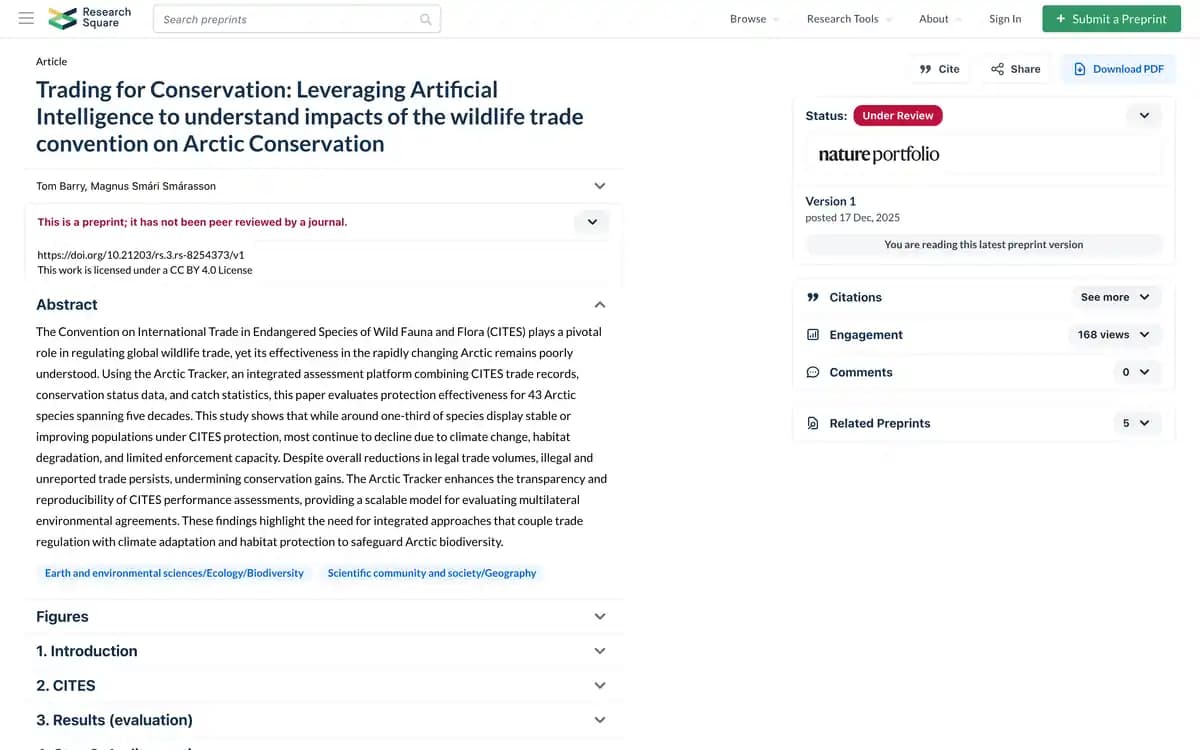
Arctic Tracker
A data platform integrating 473,000+ CITES trade records, IUCN assessments, and illegal seizure data for 43 Arctic species. Co-authored preprint with Dr. Tom Barry now under review.

BORG
The University of Akureyri's hybrid AI platform, combining commercial models with on-premise infrastructure so sensitive data stays on the university network.
Gjöll
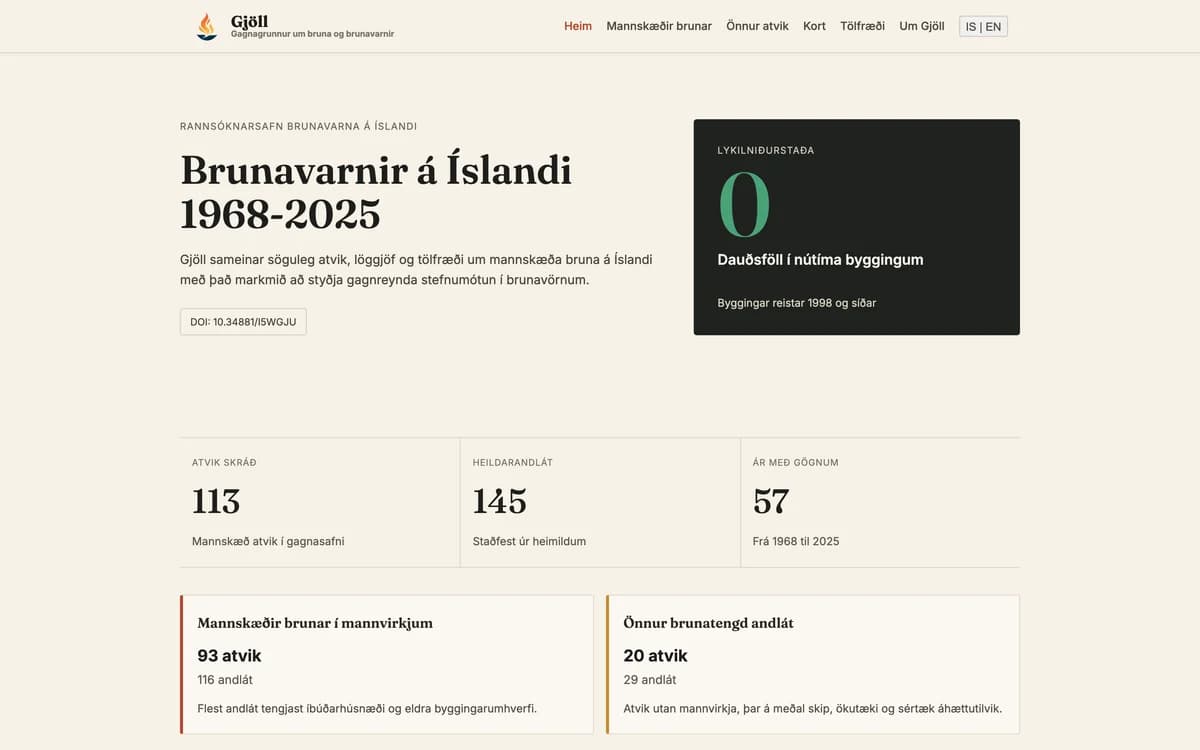
An open-access database documenting every confirmed fire fatality in Iceland since 1968, each traced to its sources. The death rate is 2 to 5 times lower in buildings constructed after 1998 than in older stock.