Gjöll
Iceland's fire fatalities database, 1968–present
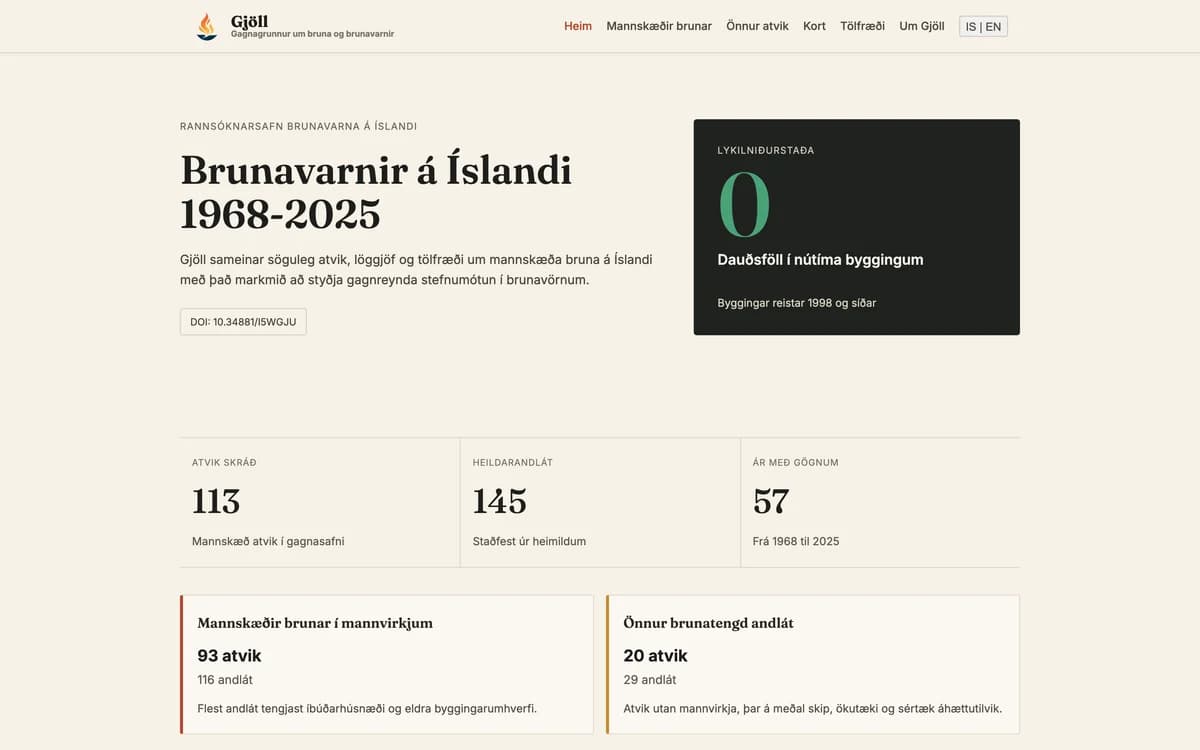
An open-access database documenting every confirmed fire fatality in Iceland since 1968, each traced to its sources. The death rate is 2 to 5 times lower in buildings constructed after 1998 than in older stock.
The Challenge
Iceland's official fire fatality statistics contained systemic inconsistencies. No single authoritative source existed that compiled, cross-referenced, and verified every fire-related death across the country's history. Policymakers, fire departments, and researchers lacked the reliable longitudinal data needed to assess whether building regulations and fire safety measures were actually saving lives.
The Approach
Manual data collection from multiple independent sources — news archives, fire department records, official statistics — with each incident checked against at least two independent sources where available. The platform is built with Vue.js 3 and Vite on a self-hosted backend — PostgreSQL and PostgREST on its own infrastructure — offering time-series analysis and downloadable datasets. All verified data are deposited in Gagnís, the University of Iceland's centralized research data repository, ensuring long-term institutional preservation.
Outcomes
Gjöll is a digital database and analytical platform that documents every confirmed fire-related death in Iceland from 1968 to the present. The project began in 2023 as a personal investigation into the reliability of official fire statistics — and quickly uncovered systemic inconsistencies in government records that had gone unquestioned for decades.
The registry holds 113 incidents and 145 deaths from 1968 to 2025. Fire mortality fell by about 80% from its 1970s peak of 21.9 deaths per million to 4.6 per million in the 2010s, and the decline began well before 1999.
The most significant finding: the fire death rate is 2 to 5 times lower in buildings constructed after 1998 than in older stock, depending on how exposure is estimated. Under the study's classification rule, no one has died in a fire in a building constructed after 1998. Under the standard international convention there is one such death, in a nursing home in 2014. The registry cannot say whether the 1998 regulation caused the lower rate, and the time-series analysis finds no break at 1999.
The Name
Gjöll is the name of the river that flows through Helheim in Norse mythology — the realm of the dead. The name reflects both the gravity of the dataset and its purpose: to illuminate the darkest chapters of Iceland's fire safety history so that future tragedies can be prevented.
Methodology
Every incident is checked against at least two independent sources where available, drawing on news archives, fire department records, and official statistics. Where discrepancies exist, the verification chain is documented. The result is the most comprehensive and auditable record of fire fatalities in Icelandic history.
The platform is built with Vue.js 3 and Vite, on a self-hosted PostgreSQL database exposed through PostgREST. It provides time-series analysis tools, and downloadable datasets for researchers, fire departments, policymakers, and the public. All data are additionally deposited in Gagnís, the University of Iceland's centralized research repository (DOI 10.34881/I5WGJU), and the analysis code is open at github.com/Magnussmari/gjoll-fire-technology.
Policy Implications
The data has direct implications for Icelandic fire safety policy. Fire safety inspection powers focus on commercial and industrial buildings, and the registry shows where residential risk sits. The 2020 Bræðraborgarstígur fire in Reykjavik, which killed three people in the deadliest residential fire in recent Icelandic history, occurred in an older building that predated modern code requirements.
Fatal fire risk now concentrates in older buildings. Fifty-eight years of records show where it sits; the open question is what to do about the older housing stock.
Technology Stack
Lessons Learned
- Official statistics are not necessarily reliable. Cross-referencing revealed systemic gaps in government fire fatality records that had gone unquestioned for decades.
- The fire death rate is 2 to 5 times lower in buildings constructed after 1998 than in older stock, depending on how exposure is estimated. The registry does not show whether the regulation itself caused the difference.
- Open data creates accountability. Publishing the full verified dataset means anyone can audit the methodology, challenge the conclusions, or extend the research.
Related Projects
View all projects →
Beyond Fragmentation
Why AI governance fails by design — and why the harms this thesis documents result from institutional choices rather than technological inevitability.

BORG
The University of Akureyri's hybrid AI platform, combining commercial models with on-premise infrastructure so sensitive data stays on the university network.
Arctic Tracker
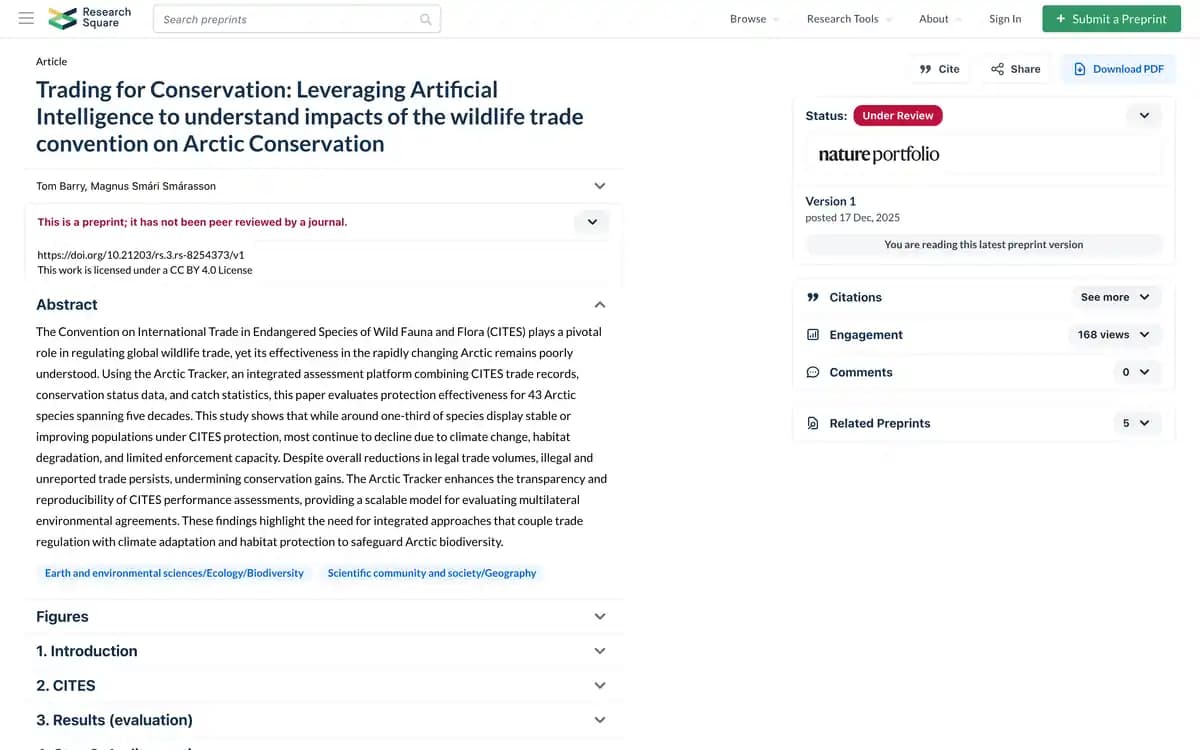
A data platform integrating 473,000+ CITES trade records, IUCN assessments, and illegal seizure data for 43 Arctic species. Co-authored preprint with Dr. Tom Barry now under review.