Arctic Tracker
Conservation intelligence for Arctic species trade
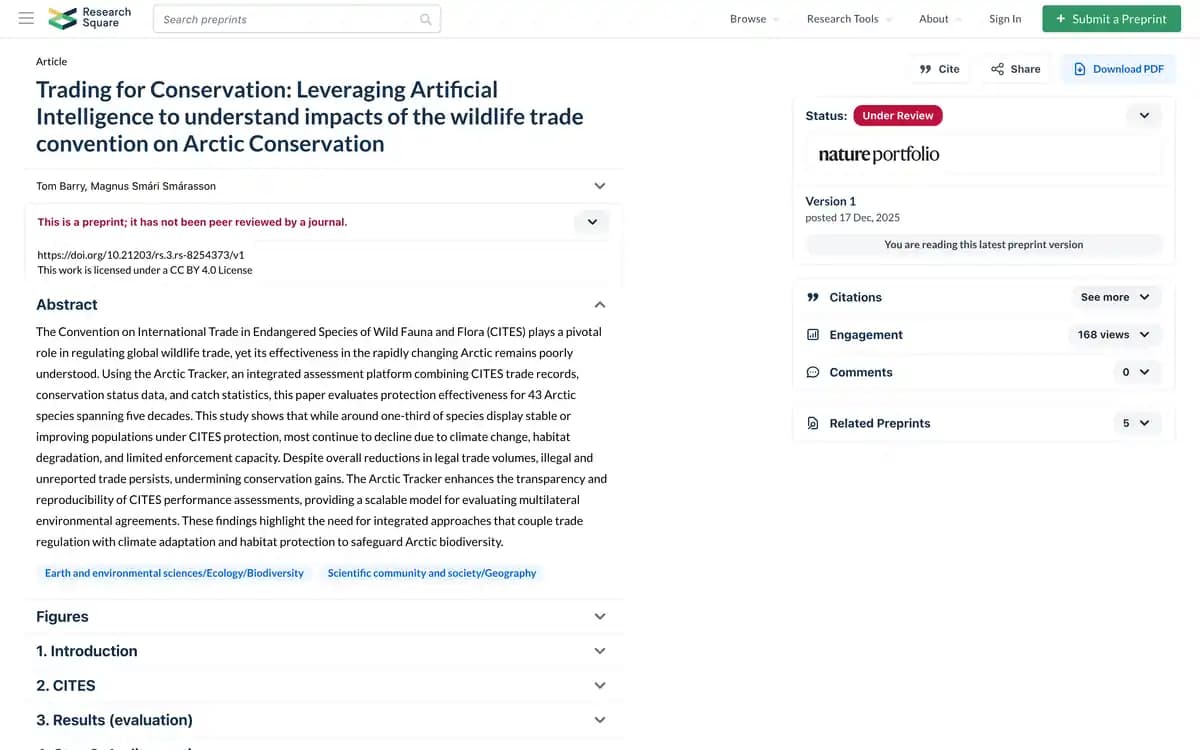
A data platform integrating 473,000+ CITES trade records, IUCN assessments, and illegal seizure data for 43 Arctic species. Co-authored preprint with Dr. Tom Barry now under review.
The Challenge
Conservation data for Arctic species is scattered across CITES trade databases, IUCN assessments, CMS listings, and NAMMCO catch records. No single platform integrates these sources, making it nearly impossible to assess whether trade conventions are actually protecting Arctic wildlife. Researchers rely on fragmentary data — individual trade records, single-species assessments — without the cross-referencing needed to detect systemic patterns. Meanwhile, climate change accelerates threats faster than traditional assessment cycles can track.
The Approach
Arctic Tracker unifies five international data sources into a single analytical platform. Python ETL pipelines process raw data from CITES (473,102 trade records), IUCN (322 assessments), CMS (31 species listings), and NAMMCO (958+ catch records), loading into a PostgreSQL database across 18 normalized tables. The React/TypeScript frontend provides species-level detail pages with tabbed views across all data dimensions. Seven publication-ready interactive visualizations built with Plotly support the research paper. A pre-aggregation layer reduces query response from 3–5 seconds to under 500 milliseconds. An MCP server enables AI assistants to query the database directly for real-time cross-referencing during research.
Outcomes
Arctic Tracker is a data platform and analytical environment built to answer a question that conservation policy has skirted for decades: are international trade conventions actually protecting Arctic wildlife? The platform integrates 473,102 CITES trade records, 322 IUCN assessments, 881 illegal trade seizures, and NAMMCO catch statistics for 43 Arctic species — making visible what was previously scattered across incompatible international databases.
The project is a collaboration with Dr. Tom Barry at the University of Akureyri. A preprint — Trading for Conservation — was published on Research Square in December 2025 and is currently under review.
The Research
The study evaluates CITES effectiveness across five decades. The findings are sobering: of the 43 species, 8 (18.6%) show high CITES effectiveness, 5 (11.6%) moderate, and 30 (69.8%) limited. Legal trade volumes have reduced, but illegal trade persists — and the data reveals that climate change, not trade, has become the dominant threat to most Arctic species.
This matters because conservation policy still treats trade regulation as the primary lever. The data suggests a more complex reality: protection regimes designed in the 1970s are encountering environmental pressures they were never built to address. Arctic Tracker makes these patterns visible so that evidence — not assumption — drives the next generation of conservation decisions.
Architecture
The platform comprises three components: a Python ETL backend for data processing, a PostgreSQL database with PostGIS and 18 normalized tables, and a React/TypeScript frontend with 45+ page components.
- Backend — Python 3.12 with 30+ ETL scripts for CITES, IUCN, CMS, and NAMMCO data ingestion. Pandas and NumPy for analysis. Automated quality assessment and database auditing.
- Database — self-hosted PostgreSQL with PostGIS, 18 tables covering species, trade records, assessments, catch data, illegal seizures, conservation measures, and distribution ranges. Pre-aggregated summary tables for sub-500ms query performance.
- Frontend — React 18 with TypeScript, Vite, TanStack Query, Shadcn UI, and Tailwind CSS. Species detail pages with tabbed navigation across trade, assessment, catch, illegal trade, and timeline data. Admin panel for data management.
- Visualizations — Seven publication-ready interactive figures built with Plotly: trade patterns, enforcement analysis, partner networks, conservation status trends, status change heatmaps, illegal seizure analysis, and wild-origin trade flows.
- MCP Server — A TypeScript Model Context Protocol server connects AI assistants directly to the database, enabling real-time cross-referencing of species data during research workflows.
Data Governance
No automated scraping of unverified sources. Every record is traced to its international source database. Data quality scripts run automated audits across the full dataset.
Update — July 2026
The platform was moved off a hosted backend and onto its own infrastructure. The database now runs PostgreSQL with PostGIS on dedicated hardware, with PostgREST as the access layer, GoTrue for authentication, and independent backups. The data model, the ETL pipelines, and the frontend are unchanged — the move was about hosting and custody of the data, not about functionality.
Technology Stack
People
Resources
Lessons Learned
- Integrating multiple international databases reveals patterns invisible in any single source — cross-referencing trade volume with IUCN status changes showed CITES protection working only weakly for 30 of the 43 species.
- Climate change, not illegal trade, emerged as the dominant threat. The data challenges the assumption that stronger trade enforcement alone can protect Arctic species.
- Pre-aggregation is essential for research platforms. Summary tables transformed the experience without sacrificing analytical depth.
- An MCP server connecting AI assistants directly to the database created research workflows that would have taken weeks manually.
Related Projects
View all projects →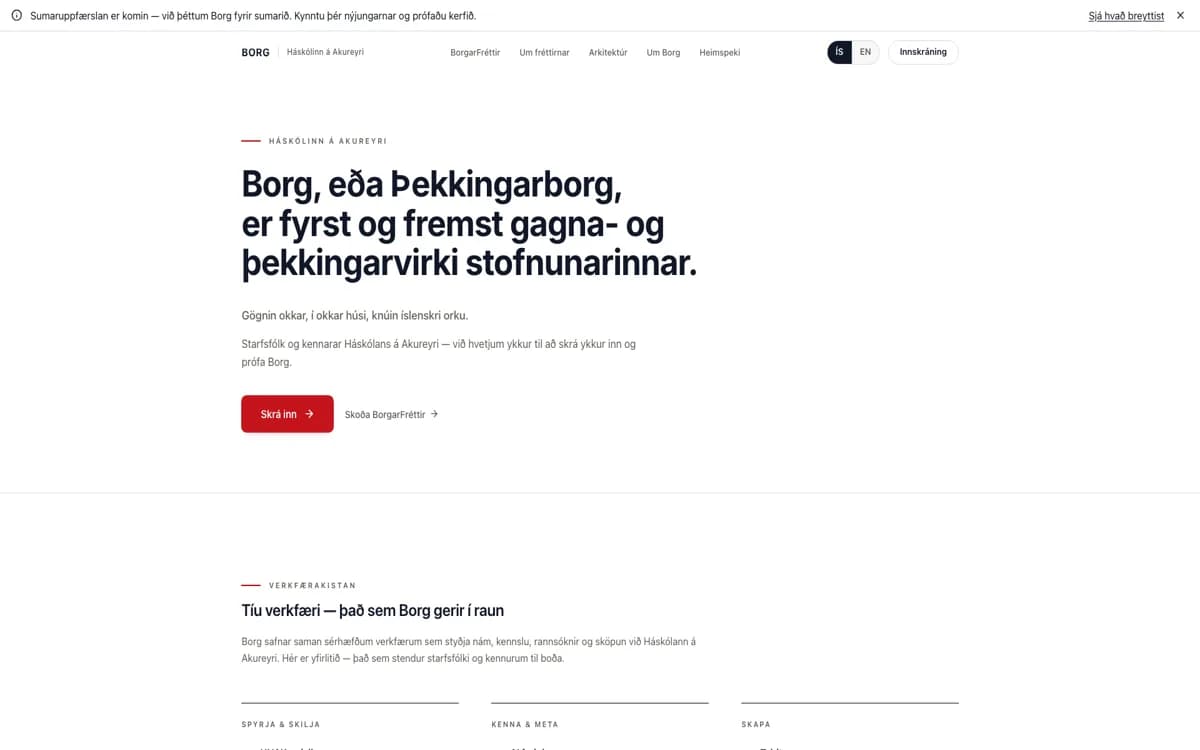
BORG
The University of Akureyri's hybrid AI platform, combining commercial models with on-premise infrastructure so sensitive data stays on the university network.
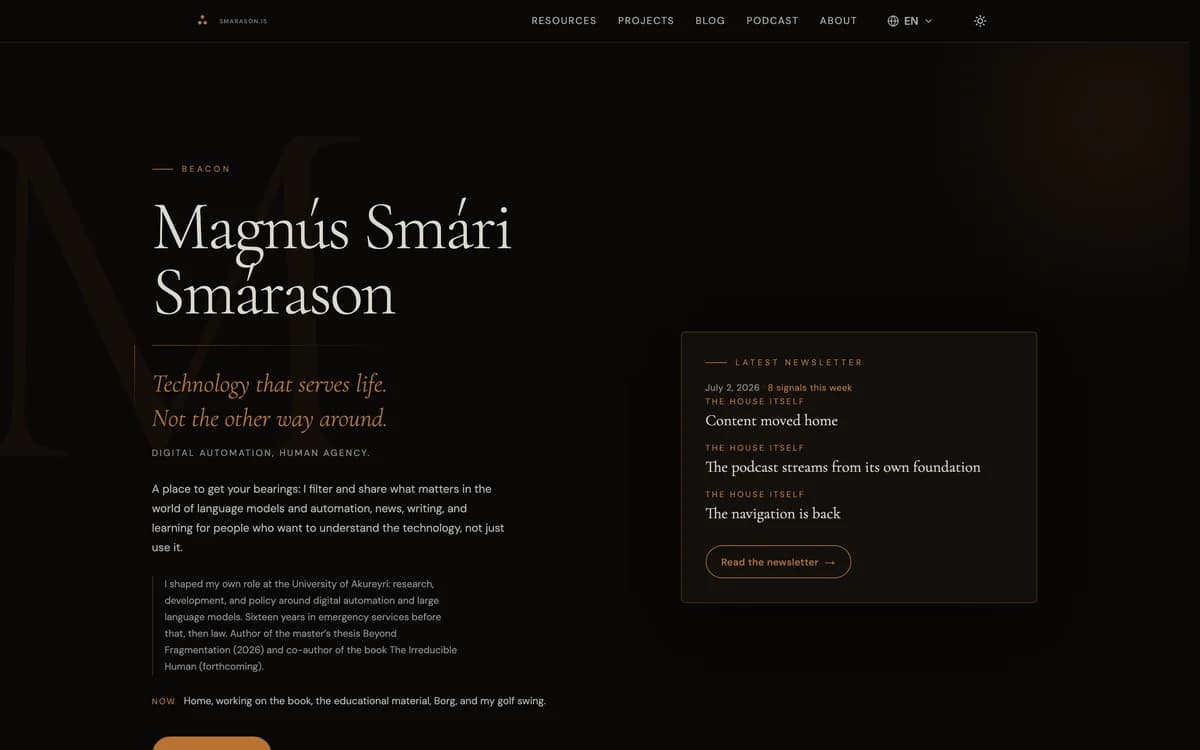
Smarason.is
A personal site moved home: Next.js 16 + Payload on its own Hetzner edge with Caddy, no cloud content service, zero tracking. The architecture is the philosophy — sovereignty over your own data.
Institutional Knowledge Graph
Small organisations run on invisible architecture — governance, systems, policies, dependencies that live in people’s heads. This is the complete methodology for making that architecture queryable: Neo4j, JSON-LD, SHACL, and a pipeline that is always safe to re-run.