Smarason.is
The site you are looking at — moved home onto its own foundation
A personal site moved home: Next.js 16 + Payload on its own Hetzner edge with Caddy, no cloud content service, zero tracking. The architecture is the philosophy — sovereignty over your own data.
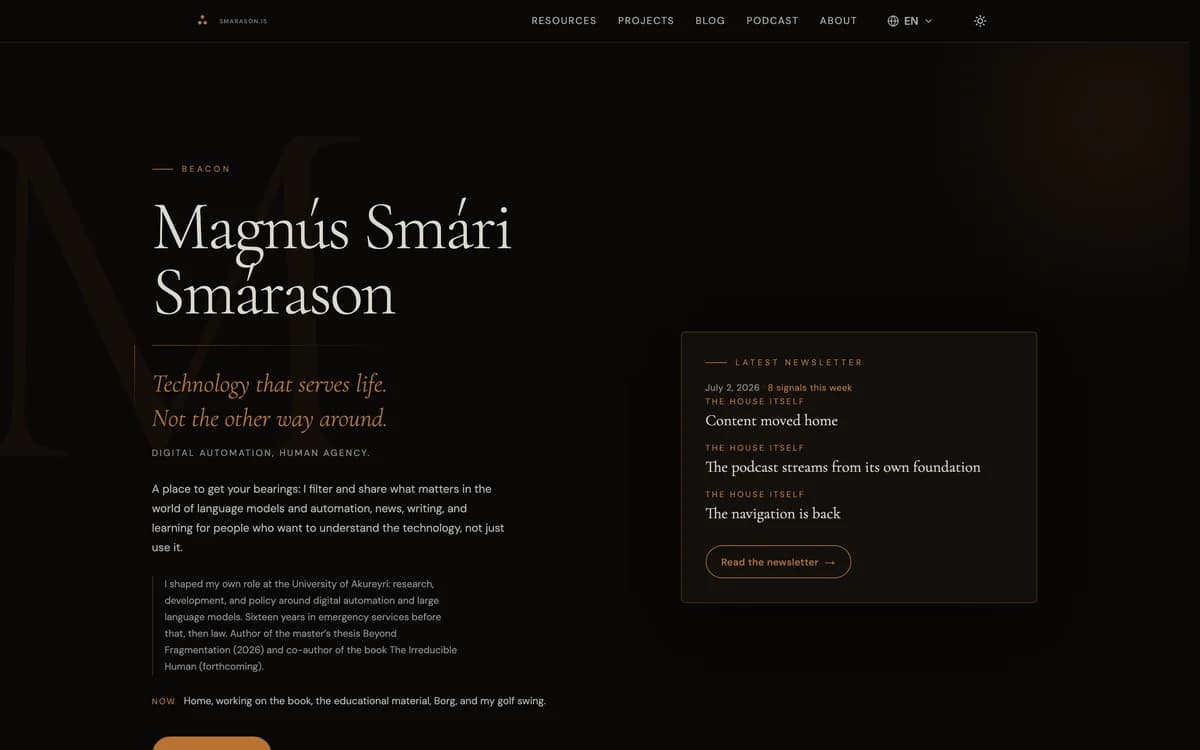
This is the site you are looking at. It exists to share work, ideas and tools — not to sell anything. No analytics, no cookies, no tracking. The architecture reflects a simple conviction: technology should serve the people who use it.
In the summer of 2026 it moved home. What once stood partly on rented ground — the content in a cloud content service, in someone else's system — now owns everything itself.
Sovereignty
- Own content system. Payload replaced the cloud content service. The content — every article, every podcast — lives in its own database on its own machine.
- Own edge server. The site runs on a small Hetzner machine with Caddy as the only listener. Certificates issued and renewed automatically on our own server, HTTP/3, no middleman — no external proxy any more.
- Own audio and images. Every podcast file and every image is self-hosted. Not one byte comes from an external content service.
- Own Git and backups. The code lives on our own Git server; database and media are backed up automatically to a separate storage box every night.
Architecture
- Next.js 16 — App Router, ISR on content pages, RSC-first with near-zero client JS.
- Payload 3 + PostgreSQL — structured content, per-document localization (Icelandic default), migrations in production.
- Caddy — automatic TLS, HTTP/3, security headers; the only public listener.
- CrowdSec — community-driven abuse defense at the edge.
- Strict TypeScript — noUncheckedIndexedAccess, no
any; errors caught at compile time.
Voice and design
Void/copper/bone — an editorial palette in OKLCH, Cormorant paired with DM Sans. Motion serves comprehension, never decoration: no gradients, no glass sheen. The aesthetic is deliberately quiet.
How it's built
Built with Claude Code and agentic systems that handle everything from content to Icelandic language quality — the human hand decides, the machine amplifies. The method is always the same: choose well, verify, deliver on your own foundation.
Technology Stack
Related Projects
View all projects →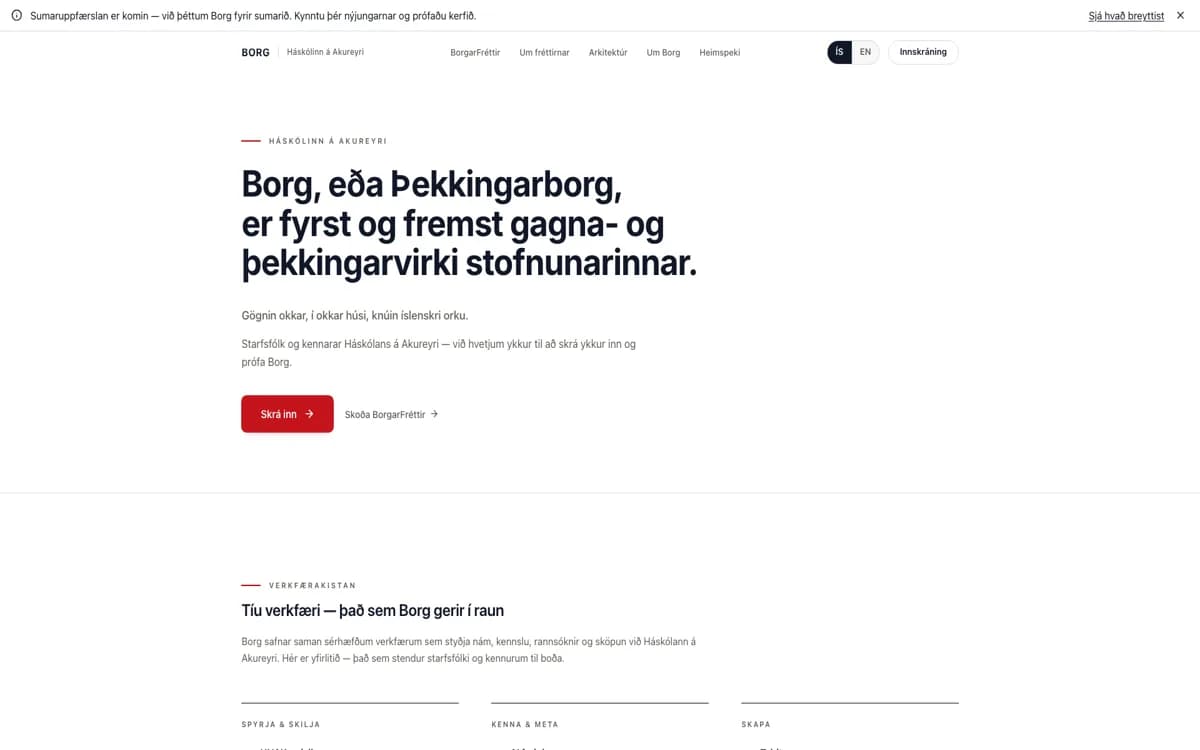
BORG
The University of Akureyri's hybrid AI platform, combining commercial models with on-premise infrastructure so sensitive data stays on the university network.
Institutional Knowledge Graph
Small organisations run on invisible architecture — governance, systems, policies, dependencies that live in people’s heads. This is the complete methodology for making that architecture queryable: Neo4j, JSON-LD, SHACL, and a pipeline that is always safe to re-run.
Sumarhús
Owned infrastructure and an agent community: own machines, own data, own content. The agents do the work, the human hand decides.