Tvær áttir (Two Directions)
Ten Icelandic poems that read in both directions
Ten Icelandic poems in the reversible form sléttubönd: each stanza reads forwards and backwards with the same words, and the meaning turns with the order. Explained here in English.
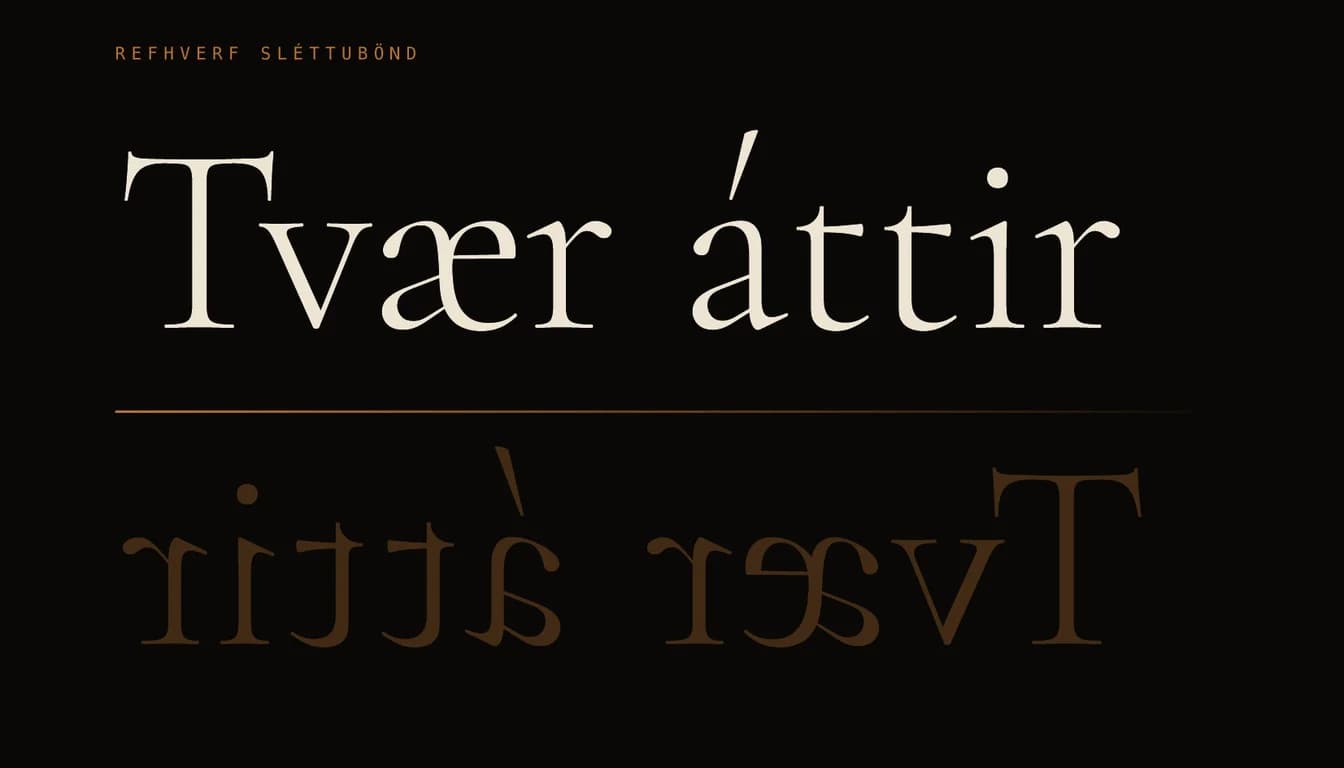
Tvær áttir (“Two Directions”) is a set of ten Icelandic poems that work in both directions. Each stanza is read forwards and then backwards, word by word, with exactly the same words. The backward reading is a second stanza with the same metre, the same alliteration and the same rhyme. The poems are in Icelandic, so this page explains what they do and why that is hard.
The form
Sléttubönd is an old Icelandic verse form: a stanza that survives being read backwards. These are refhverf, the rare kind in which the meaning turns with the order: reading backwards does not merely scan, it reverses who does what to whom. Here is stanza II, with a literal English gloss.
Forwards
mæður landsins sáttar svæfa
sætar bænda dætur
ræður feðra kaldar kæfa
kærar sumars nætur
The reconciled mothers of the land lull to sleep the sweet daughters of farmers; cold speeches of fathers smother the dear nights of summer.
Backwards
nætur sumars kærar kæfa
kaldar feðra ræður
dætur bænda sætar svæfa
sáttar landsins mæður
The dear nights of summer smother the cold speeches of fathers; the sweet daughters of farmers lull to sleep the reconciled mothers of the land.
The mothers who lulled the daughters are now lulled by them, and the nights that were smothered now do the smothering.
Why Icelandic can do this
Every stanza has four lines of 8, 6, 8 and 6 syllables with feminine rhyme, and fourteen words, all of them two-syllable words stressed on the first syllable. Because the stress falls on the same positions in both directions, the metre survives the reversal. Icelandic feminine plural nouns and adjectives have the same form in the nominative and the accusative, so the same word can be the subject in one direction and the object in the other. The alliteration (stuðlar) and the end rhymes hold in both readings.
Why I made them
The book The Irreducible Human, which I am writing with Dr. Kristian Guttesen and which is forthcoming from De Gruyter Brill, asks what in a human being cannot be reduced to an algorithm or a binary. The answer is complicated, and these poems are one way of saying so with work instead of argument. The form is rule-bound and a machine can handle it. What makes a stanza worth reading is a judgement, and that judgement cannot be computed. The experiment is called Bragi-Ω.
The spark was an article by Davíð Þór Björgvinsson in the Icelandic newspaper DV in October. He asked a machine for eight refhverf stanzas, seven turned out to be unusable, and the article ends with the words “Þá vitum við það” (“So now we know”). This is the sequel: ten stanzas that work in both directions.