Iceland's Employment Policy 2035: A Systematic Blind Spot
An open, computationally verified audit of AI-driven workforce risk
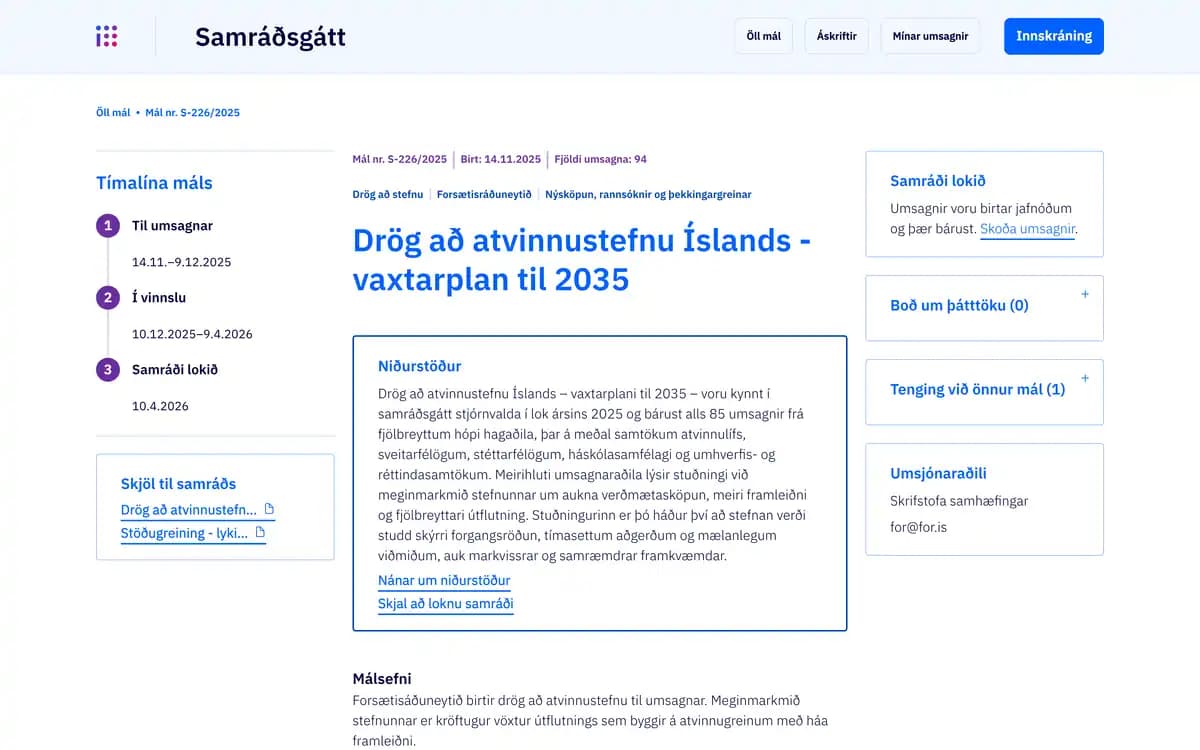
Iceland's government published a ten-year employment strategy whose 35 actions fund no way of detecting a job being automated away. This research project shows it, built from public government tables. The working repository was closed on 31 August 2026; the sources it rests on remain public.
“An employment strategy that cannot see a job disappear is not an employment strategy.
The Challenge
Iceland's Employment Policy 2035 was published without any risk assessment on AI-driven workforce disruption — despite every major international institution (IMF, OECD, WEF, ILO) having published such assessments, and despite Iceland's own ICT sector already showing measurable displacement signals. The challenge: demonstrate this blind spot rigorously enough that it cannot be dismissed as opinion. Every claim had to be computationally verified, every source linked, and the strongest counterarguments addressed before publication.
The Approach
Seven parallel research sectors, an adversarial Oracle agent, automated PDF text extraction, and a two-system verification pipeline (Manus 1.6 + Claude Code). All raw data, scripts, and verification reports published in an open-source repository. The approach draws on Responsibility Fog and Cognitive Debt from Beyond Fragmentation — applied here not to AI systems but to the governance system that produced the policy.
Outcomes
The Core Finding
The silence is structural before it is lexical. Iceland's Employment Policy 2035 comes in three documents — the Vaxtarplan til 2035, its Aðgerðaáætlun 2026–2027, and the Stöðugreining that diagnoses the starting position. Between them they commit to 35 numbered actions and nine headline metrics. Not one action funds displacement monitoring, a retraining entitlement for workers whose jobs are automated, or transition support — the nearest thing, ISK 200 million a year for flexible university study pathways, is voluntary upskilling. Not one of the nine metrics tracks employment stability, worker transitions, or welfare inflows, and not one carries a target, a baseline, a stated method, or a date. The plan puts ISK 1,100 million into gervigreind infrastructure and nothing into measuring what that infrastructure does to the workforce.
The vocabulary follows the architecture. Across all three documents, automated text extraction — reproducible in minutes — finds zero occurrences of sjálfvirkni (automation), röskun (disruption), atvinnumissir (job loss), endurþjálfun (reskilling) and umskipti (transition). Gervigreind appears thirteen times, every time as opportunity, capability or infrastructure — never once as a risk to employment. Atvinnuleysi (unemployment) appears four times: three of them looking backwards, at the fall from 8.3% to 3.4% over the 2010s, and one flagging a divergence between Icelandic-born and foreign-born workers. Not once does the word stand in the same breath as the technology.
Reproduce this yourself:
pip install requests && brew install poppler
python3 scripts/02_verify_textanalysis.py
The ICT Pattern
Iceland's ICT sector (NACE J, the European industry classification for information and communications) moves on four measures at once, and they point the same way. Annual figures, conservative 2022 baseline:
- Revenue (J62 computer services): +28.1% (2022→2024)
- Employment: flat — 9,029 (2024) to 8,848 (2025) on Hagstofa's full-population tax register, down 2.0% from peak and up 10% on 2019. (The Labour Force Survey shows a steeper fall, 11,400 to 10,100, but publishes ±1,200 and ±1,100 confidence intervals on those two estimates; that difference is not statistically significant. The register is the harder source.) Employment held while revenue grew 28% — which is the productivity story, stated correctly
- Vacancy rate: 4.13% → 0.72% (annual means, 2022→2025) — a fall of 83%, the steepest of the ten broad sectors Hagstofa publishes, against 47% for the economy as a whole
- Labour productivity: +10.5% (highest of any sector in Iceland, 2025)
Revenue up, headcount flat, vacancies gone, productivity the highest in the country. That is not what a post-COVID correction looks like — revenue would have fallen too, and it grew 28%. But consistent is not the same as proven, and this analysis does not claim otherwise. A demand correction after an exceptional hiring run, changed subcontracting, mergers, a shift in what the classification counts, and above all the global contraction in technology funding across 2022–2024 all fit the same timing. Manufacturing vacancies fell almost as steeply over the same period (−78%), in an industry where the displacement story does not apply. Something cooled hiring across the tradeable economy, with information and communication at the front of it.
Which of those it was, nobody in Iceland can say — and that is the finding. The signals sit in four separate public tables: JVS00001 (vacancies), VIN10022 (register employment), FYR04101 (turnover), THJ11011 (productivity). Assembling them took a laptop and an afternoon. No published Icelandic work assembles them: of 174 theses on gervigreind in the Skemman repository, one BS thesis touches labour displacement, and none of the eight Rannís grants awarded in the field funds labour-market research. That search covers universities and student work — it says nothing about unpublished analysis inside Hagstofa, Vinnumálastofnun, Seðlabankinn or the ministries, and no claim is made about those. The point is not that the pattern was hidden. It is that no Icelandic institution has a standing duty to look for it.
The Knowledge-Occupation Collapse
"This is not a forecast. This is a record of what has already occurred."
Between 2024 and 2025, Iceland lost 9,300 knowledge-intensive jobs — managers, professionals, associate professionals, and clerical staff (ISCO groups 1–4, −6.9%) — while gaining 6,900 physical and service jobs (ISCO groups 5–9, +7.4%). The economy did not contract; its composition shifted. The policy prescribes more STEM investment for a knowledge sector that is already contracting. The prescription directly contradicts the data.
Iceland Is Flying Blind
Iceland is the only Nordic country absent from every key European AI and labour measurement instrument:
- Eurostat isoc_eb_ai: Denmark 42.0%, Finland 37.8%, Sweden 35.0%, Norway 28.9% — Iceland: not surveyed
- EWCS 2024 (Eurofound worker conditions survey): 35 countries, Iceland not among them. An Icelandic equivalent would cost, on this project's own costing, ISK 8–12 million. One percent of the plan's gervigreind infrastructure line would have bought it. It is not funded
- Linked administrative data: Denmark has DREAM+IDA, Sweden LISA, Norway FD-Trygd, Finland Findata. Iceland has rich registers at Hagstofa, Vinnumálastofnun, Tryggingastofnun and Sjúkratryggingar — and no statutory framework for joining them for research. Denmark's linkage is what let researchers measure this question directly on 500,000 workers; Iceland's registers cannot be joined to ask it at all
- Union AI agreements: Denmark (Hilfr2), Norway (LO-NHO), Sweden (Teknikföretagen-IF Metall) — Iceland: none
Additionally, Ríkisendurskoðun (National Audit Office) found a 17% discrepancy between Iceland's two official unemployment measures — Hagstofa (5.2%) vs. Vinnumálastofnun (3.3%) for the same month.
The Institutional Silence
When Iceland's government published its AI Action Plan for consultation — projecting 130,000 workers (55%) "greatly affected" by AI — not a single major labour union submitted a response in the 14-day window. ASÍ (Confederation of Labour), VR, Efling, BSRB, SFR, and KÍ were all absent. Iceland's largest union congress (ASÍ 46th, October 2024) passed zero resolutions on AI.
A Varða 2026 survey of 25,000 Icelandic workers found: 23% already affected by technology change, 36% fear job loss, 45% feel undertrained, 44% report increased work pressure (56% among immigrant workers).
Theoretical Framework
This analysis applies two concepts from Beyond Fragmentation (MA thesis, University of Akureyri, 2026) to a live policy document:
- Responsibility Fog: Systematic diffusion of accountability — institutions that should have responded to the AI consultation did not; no single actor bears responsibility for the collective silence.
- Cognitive Debt: A strategy built on international estimates never validated domestically, governing through borrowed statistics rather than observed data. The government's own "130,000 affected workers" projection uses a framework it has not validated for Icelandic conditions.
Verification
Findings were run through two independent systems (Manus 1.6 and Claude Code) and three precision corrections were applied. A later audit found what both had missed: the text analysis had been run against the November 2025 consultation deck rather than the strategy published in April 2026. It has been re-run against all three published documents, and the figures on this page are the corrected ones. Two systems agreeing is not verification if both are reading the wrong file — document provenance is checked first now. The correction is in the repository with everything else.
Eight Formal Data Requests
Eight formal information requests under Iceland's Freedom of Information Act (Upplýsingalög nr. 140/2012) have been prepared but not yet submitted to: Tryggingastofnun, Vinnumálastofnun, Hagstofa Íslands (×2), Sjúkratryggingar Íslands, Ríkisendurskoðun, Forsætisráðuneytið, and the Ministry of Higher Education, Industry and Innovation (Háskóla-, iðnaðar- og nýsköpunarráðuneytið). This page will be updated once the requests have been filed. Responses will be added to the repository as they arrive.
Technology Stack
Resources
Lessons Learned
- Computational verification is not just quality control — it is the argument itself. But a script is only as good as the file it points at: verify the document's provenance before you verify its contents.
- Presenting both a conservative and a broad statistical baseline is stronger than the more dramatic number alone. Acknowledging the COVID-bubble concern preemptively closes the strongest counterargument.
- The strongest finding (9,300 knowledge jobs already lost) is not a forecast. Emphasising what has already happened is more powerful than projecting what might.
- Open-source evidence is harder to dismiss than a closed report. A repository with 150,000 rows of public data and reproducible scripts changes the terms of the debate.
- Two independent systems both verified a word count against the wrong document — a consultation deck, not the published strategy. Agreement between models is not evidence when both are pointed at the same wrong input. The check that would have caught it is the cheapest one available: read the PDF metadata first.
Related Projects
View all projects →
Beyond Fragmentation
Why AI governance fails by design — and why the harms this thesis documents result from institutional choices rather than technological inevitability.
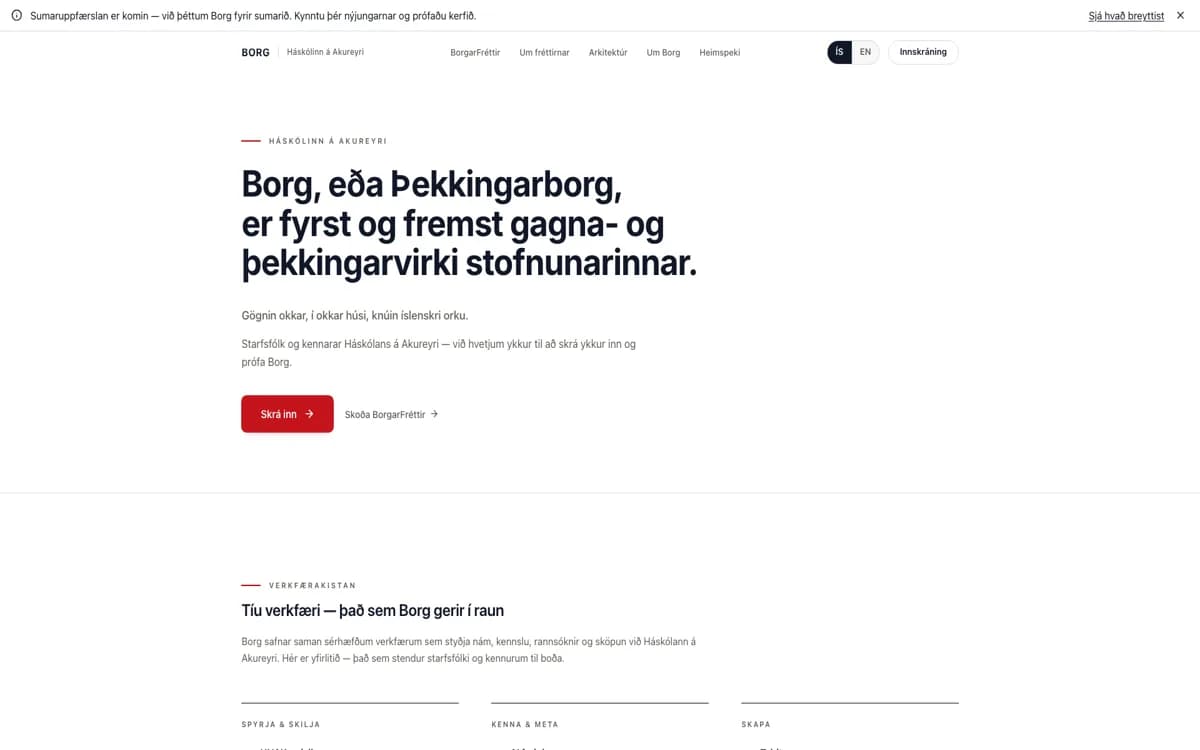
BORG
The University of Akureyri's hybrid AI platform, combining commercial models with on-premise infrastructure so sensitive data stays on the university network.