beethoven.is
A database of complete Beethoven symphony cycles on CD
A music critic’s years of collecting: 190 complete Beethoven symphony cycles (4 November 2026), with published track timings and made searchable. Next.js 16 + Payload on our own infrastructure.
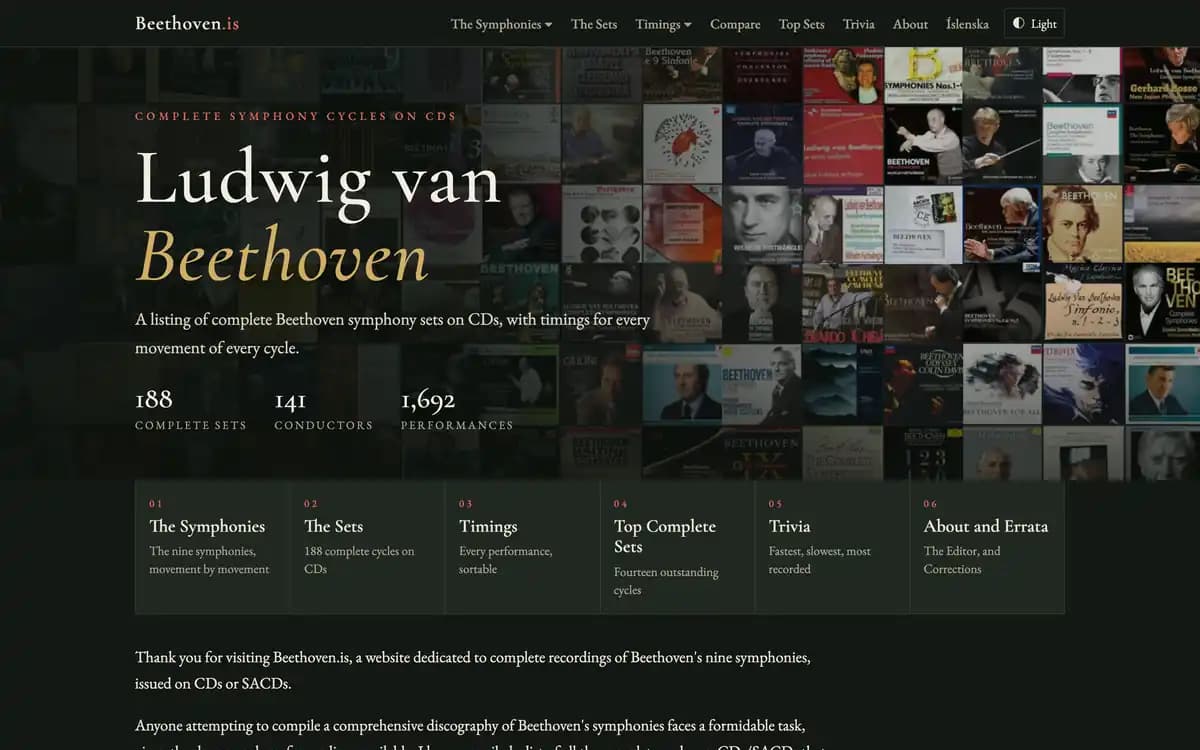
Magnús Lyngdal Magnússon is a historian, music critic and former trumpeter. For years he has collected complete cycles of the Beethoven symphonies on CD and compiled their published movement timings. On beethoven.is the collection is open to everyone.
The challenge
Magnús Lyngdal supplied the catalogue and its context in Excel; I transcribed his data and built the website. The task was to make it searchable and comparable without losing what makes it valuable: these are published track durations compiled by the editor. The editor also had to be able to maintain all of it himself.
The solution
- The whole collection in one system. 190 cycles, 142 conductors and 1,710 recordings as of 4 November 2026. Every symphony has its page, every cycle has its page, and the timing tables sort by any column.
- Comparison. Two cycles side by side, movement by movement, with Bärenreiter urtext reference times for comparison.
- The editor’s voice. His own ranking of the best cycles, trivia and an errata list. The Icelandic section carries his 93 segments from Morgunvaktin on RÚV Rás 1 and the series Undir geislanum, all playable.
- Readable by people and machines. Pages work without JavaScript, every page also exists as Markdown, and the data can be downloaded as JSON or CSV. No cookies and no tracking.
- The editor owns the work. The editor adds cycles, covers and rankings himself and corrects what needs correcting. The site runs on our own infrastructure and stays up while a new release goes in.
The site was built at Sumarhús and went live on 14 October 2026.
Technology Stack
Related Projects
View all projects →
BORG
The University of Akureyri's hybrid AI platform, combining commercial models with on-premise infrastructure with an option for processing on the university network.
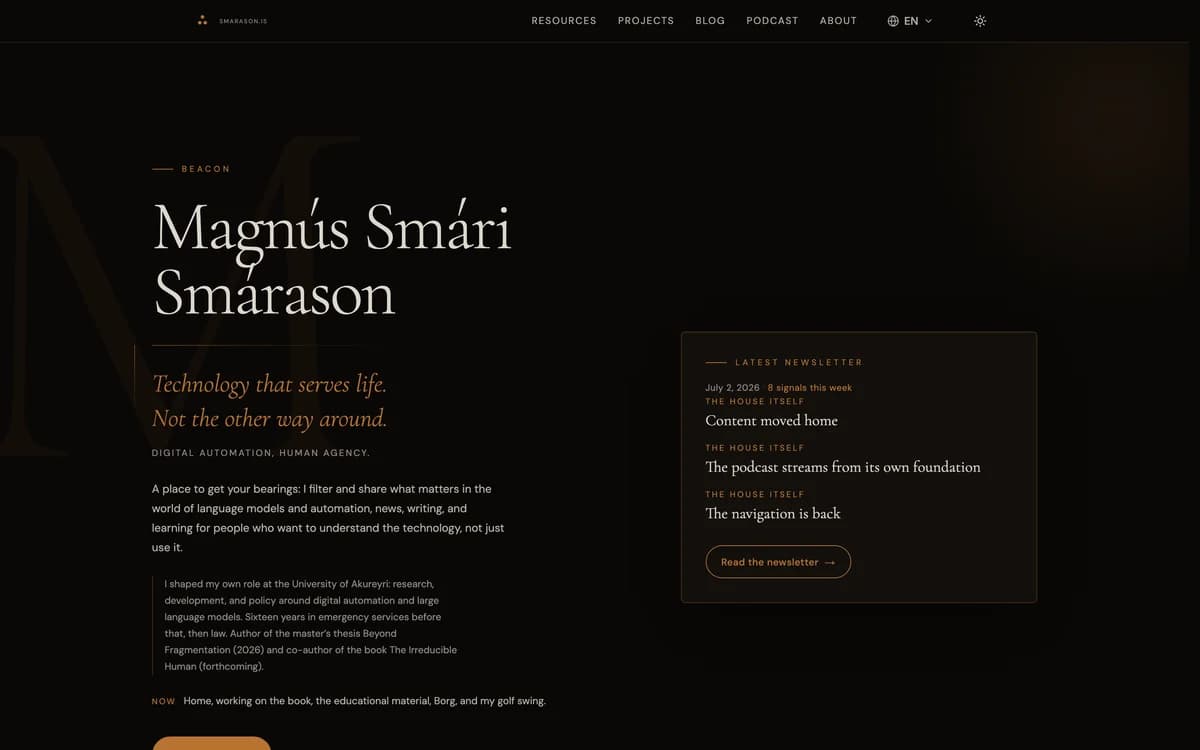
Smarason.is
A personal site moved home: Next.js 16 + Payload on its own Hetzner edge with Caddy, no cloud content service, no first-party analytics. The architecture is the philosophy — sovereignty over your own data.

Institutional Knowledge Graph
Small organisations run on invisible architecture — governance, systems, policies, dependencies that live in people’s heads. This is the complete methodology for making that architecture queryable: Neo4j, JSON-LD, SHACL, and a pipeline that is always safe to re-run.