Born to Ruck
The Science of Weighted Walking and the Exercise Your Body Was Built For
Open-source science book on rucking — 14 chapters, 86 DOI-verified citations, and the honest acknowledgment that the most complete exercise your body can do requires a backpack and a closed mouth.
“The human body is not a running machine. It is a carrying machine.
The Challenge
The evidence for weighted walking as a comprehensive longevity exercise is spread across evolutionary anthropology, military science, osteogenic mechanics, endocrinology, and respiratory physiology — disciplines that publish in separate journals, use different terminology, and have rarely been synthesised for a general audience. The fitness industry had no incentive to do this synthesis: the protocol requires a backpack and an open trail, not a subscription, a gym membership, or proprietary equipment. The book needed to be rigorous enough for researchers (DOI-verified citations, disclosed evidence gaps, adversarial bias audit), accessible enough for a curious forty-year-old who wants to understand what they are doing and why, and honest enough to state clearly when the evidence is strong and when it is inference.
The Approach
AI-augmented science synthesis, with the human as orchestrator and the AI as research and drafting infrastructure. The workflow: structured literature reviews in Scite.ai → chapter outlines written by the author → 16 parallel Claude agents (via the PAI Claude Code infrastructure) writing all 16 chapters simultaneously → adversarial bias audit with 11 parallel research agents → manual editorial review and revision → Quarto rendering pipeline producing HTML, PDF, and EPUB from a single source. Citation standard: every factual claim must trace to a DOI in references.bib. No hallucinated citations — if Scite cannot find it and the DOI does not resolve, it does not go in the book. The full methodology is documented in Appendix B (prompts) and Appendix C (bias audit) — reproducible by design.
Outcomes
The Problem With Fitness Advice
Most fitness books either sell you a programme or sell you an identity. Neither is the same as assembling the available evidence, stating what it actually shows, disclosing where it stops short, and handing you a protocol grounded in what the human body was evolutionarily designed to do.
The evidence for weighted walking — rucking — is scattered across disciplines that rarely talk to each other: evolutionary anthropology (the case that bipedalism co-evolved with load carriage, not running), military exercise science (the only population that has been systematically studied rucking under real loads), osteogenic mechanics (the bone-loading stimulus that running generates poorly and weighted walking generates well), endocrinology (the hormonal case against chronic high-volume endurance training), and respiratory physiology (nasal breathing as an intensity regulator with documented metabolic consequences). No general-audience book had synthesised this. Born to Ruck is that synthesis.
How the Book Was Written
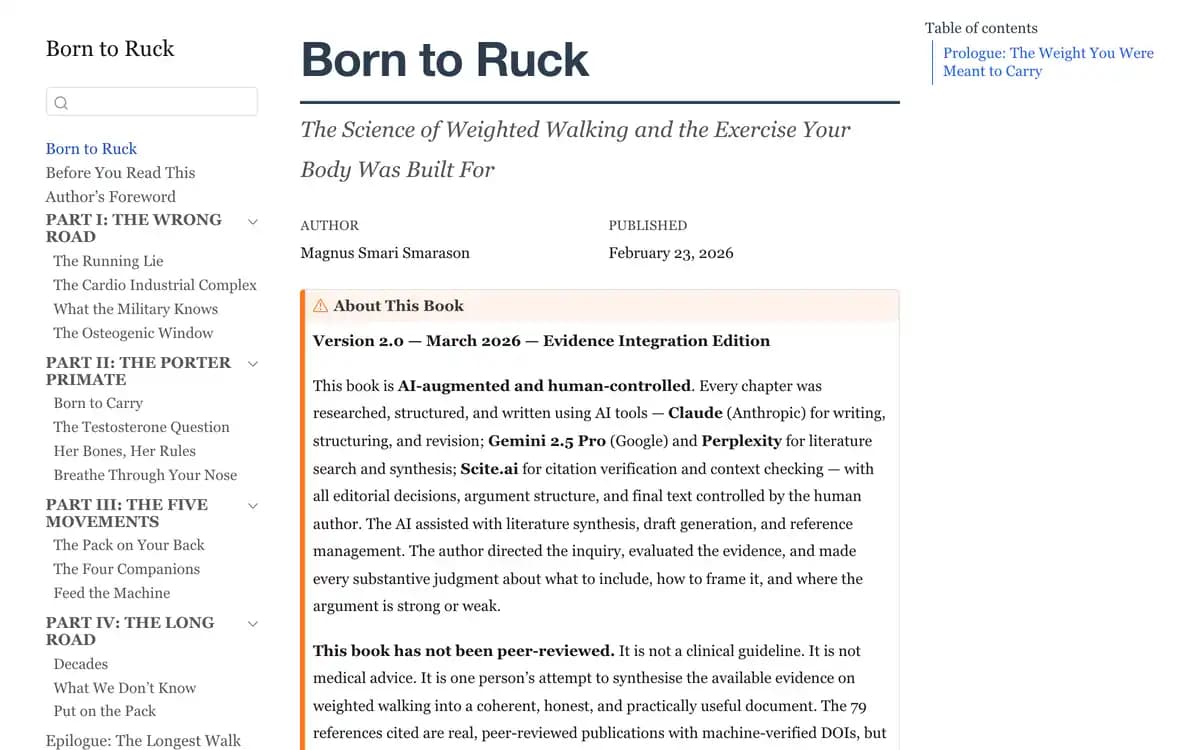
The book is a reference implementation of AI-augmented science writing. Sixteen parallel Claude agents wrote all sixteen chapters simultaneously using the PAI (Personal AI) infrastructure — while the author was out rucking. The AI did literature retrieval, synthesis drafting, and citation verification. The author directed the inquiry, evaluated the evidence, and made every substantive judgment about what to include, how to frame it, and where the argument is weak.
Every factual claim traces to a DOI in the bibliography, verified through Scite.ai's smart citation system. After the manuscript was complete, the same infrastructure was redirected adversarially: eleven parallel research agents spent twenty-five minutes finding confirmation bias across all twelve subject-matter chapters. Counter-evidence was integrated honestly. The full account of what was found and what changed is in Appendix C: The Honest Oracle.
The result is a book with 86 peer-reviewed citations, a chapter dedicated to disclosing every significant evidence gap (Chapter 13 includes a GRADE evidence scorecard for the whole book), and an appendix documenting every AI tool used, every prompt issued, and every editorial decision made.
Structure
- Part I — The Wrong Road: The injury epidemiology of running, the commercial machinery of fitness complexity, military science civilians have ignored, and the osteogenic window every person over forty needs to understand.
- Part II — The Porter Primate: Evolutionary anthropology of load carriage, the hormonal case for weighted walking over endurance running, sex-specific evidence for women's bone health, and nasal breathing physiology.
- Part III — The Five Movements: The complete protocol — pack selection and load progression, four companion movements (farmer carry, dead hang, push-up, deep squat), and nutritional substrate.
- Part IV — The Long Road: Decade-by-decade programming from the twenties through the seventies, evidence gaps and what would close them, and the final instruction.
There is also a prologue (the man on the trail above the sixtieth parallel), a foreword (the firefighter who figured out why his seventy-seven-year-old stonemason father could outwork him), and an introduction that tells the reader to stop reading and go put on the pack.
The Protocol in Three Sentences
Start at ten percent of your bodyweight. Breathe through your nose. Add load only when it feels easy.
Everything else in the book is the evidence that explains why those three sentences, and not some other three sentences, are the ones worth following.
Icelandic Edition
A full Icelandic translation — Fædd/ur til að bera — exists and renders to HTML, PDF, and EPUB. Currently under manual review before release. The Icelandic edition will be released on the same repository once the translation review is complete.
Technology Stack
Resources
Lessons Learned
- Evidence standards are the difference between a science book and a science-flavoured opinion piece. Requiring a DOI for every claim forced every argument to be grounded — and made the gaps visible.
- Adversarial auditing should not be an afterthought. Running eleven bias-finding agents after the manuscript was complete changed the tone and claims of every chapter. The book is more honest for it.
- AI writes the draft; the author writes the judgment. The sixteen parallel agents produced synthesis that would have taken months solo. The months of work were replaced by hours of evaluation, direction, and editorial decision-making.
- Disclosing what you do not know is a feature, not a weakness. Chapter 13 (evidence gaps) and the GRADE scorecard make the book more credible, not less.
- The protocol itself is a test of the thesis. A book claiming that simplicity outperforms complexity should be simple to follow. Three sentences is the right length for the protocol.
