Season 2, Episode 9
It's not a box, it's a bucket
·1:26:43 min
What does a publisher actually do once the business becomes the data, not the book? Magnús talks with Pietro Segreto, a PhD student in Rome studying AI and publishing, about the glass box from 1423, AI as a backward-looking shadow, and the story that named the episode: it isn't a closed box, it's a bucket each generation fills for the next.
 AI
AIClick to enlarge
Guests
P
Pietro Segreto
PhD student, University of Rome Tor Vergata
Show Notes
I meant to record a conversation and forgot to hit record. We were lucky; we had only just begun. But it was a fitting reminder of something we ended up circling for almost an hour and a half: that we have no guarantee of anything. Not even that the other person is really there.
On the latest episode of Taming Technology I spoke with Pietro Segreto, a PhD student at the University of Tor Vergata in Rome. He studies how AI is changing the publishing industry. We had talked two weeks earlier and felt straight away that the conversation should have been an episode. So this time we kept everything.
What does a publisher actually do?
I opened with the naive question: will there still be a publishing industry in ten years?
Pietro turned it around. The question isn't whether books survive, but what a publisher actually is. If you tie the publisher to the object, to the book, you've misunderstood the job. A publisher is the one who chooses. The one who finds content, decides what should be published, works on it and brings it to the world. He put it simply: a publisher is “someone that makes a choice.”
What changes, he said, isn't the choosing but the means. The big academic publishers — Elsevier, Springer, Wiley — have already stopped selling you just books. They sell you services on top of their data. They license that data to the large AI companies. The publisher discovers that the business is really the data, and the question becomes how you work with it.
That was the first connection that stayed with me. Not long ago I sent Pietro a document: my walk through a few thousand years of human history seen through written records. The reason is simple. What we know about the past, we know because someone wrote it down and someone kept it. The scribe, the monk, the printer. They were the gatekeepers of knowledge between generations. They chose what was carried forward.
I think publishing will come to revolve much, much more around something I call, in my head, S-tier verification. Quality control. Real-world testing of information. Being interdisciplinary is no longer optional; it's a precondition. You can no longer hide inside a single field.
The glass box from 1423
I was writing a short story out of my master's thesis, and I told Pietro about it.
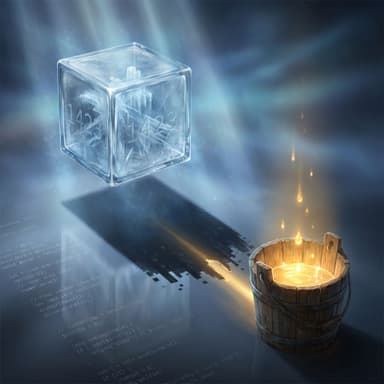
The story is set in a tribe that is given a glass box. Inside the box is all of humanity's knowledge up to the year 1423. You can ask the box and it answers, but it knows nothing after 1423. And the society stalls. It stops inventing. It stops asking. It stands still, because the box knows everything that needs knowing.
But of course a girl is born who is a bit of a rebel. She doesn't ask the box. She goes off and tinkers and finds something new. Then she brings it to the box, and the box says: I don't know what this is. Can you teach me? Teach you what? I don't understand this.
When the machine saw something it had never seen before, something that wasn't in the training data, it asked: can you teach me? Can you train me?
That is exactly what we are doing. With this podcast, with all of it, we are creating new training data as the first generation of humans who talk to large language models. I think we underestimate the training data behind these models and, at the same time, overestimate what they can tell us about a society they themselves have never lived in. The models have no data about a human society that lives alongside AI. We are writing that data, right now, for the first time.
We walk with our shadows
Somewhere in the conversation Pietro asked me to define AI. Not a scientific definition, but my own — how I feel it.
I said: this is me talking to data. It's a shadow, an extension of me talking to data. And once you realise that, you can amplify yourself.
It isn't artificial intelligence in the sense the word implies. We're just walking around with our shadows all day, because this is a statistical shadow. And the shadow is made of the past. Data always comes from what has already happened. This is a machine that looks backwards.
Pietro put it better than I did: the data is your shadow, but it's still you who has to decide the way forward. The machine rearranges, rephrases and repeats what we already have. What it cannot do is foresight — that rare, hard capacity to look ahead into a time no data covers. That, I think, is the human job.
I've been through a stretch where it felt like all of this was going to go horribly. Not depression, but a “good God, this is going to be awful.” I also went through what I call professional grief. But I'm in the acceptance phase now. And the peace came with the understanding: the shadow is not the one steering. I steer.
Mathildur's birthday
My youngest daughter turns six in mid-June. We'll be travelling that weekend, so I made her a birthday app.
I sat down with her and we had a little conversation. We used speech-to-text. What do you want for your birthday? Unicorns. Songs. Then I told my system: build a birthday app for her, I want music, pictures and videos. That was all I put in. And by the evening it was up on the TV screen at the party, with ten custom songs and flying unicorns.
Pietro asked — and he was right to — whether that is really creation. Because in the end it's just the production of something that has been seen before.
If we go by the narrowest definition of creativity, that road is hard for all of us. Music is recycled. Stories are recycled. We are shaped by everything we have heard and seen. But the creativity in the birthday app wasn't in the execution. It was in the conversation. The spark came to life between me and Mathildur, in a question from a father to his child: what do you want for your birthday? That was all the creation it needed. The rest was work.
And my system knows it is not part of that conversation. I just sat there with my phone and recorded a raw conversation between her and me. Because what AI needs is imagination, curiosity, dreams, inspiration. It needs our soul. That's where it gets something to work with.
It's the same thought that underlies school at home. A teacher is an institution, but the most important teachers in my daughters' lives are us, my wife and me. They imitate us. They are our shadow, exactly as the model is my shadow. Their lives are shaped by what they experience every day through us. That's why this matters less for which device they're handed and more for how we live in front of them.
It's not a box, it's a bucket
Here came the correction that gave the episode its name.
In my story, the little society realises one thing near the end. This is not a box. It's a bucket. A box is closed, fixed at 1423. A bucket is something you keep filling. The job of each generation is to add good things to the bucket for the next one.
And that is exactly what publishers have always done. From the very first thing that was ever published. That was the first drop in the bucket of information. It's the same information as always, the same knowledge passing from hand to hand. There is nothing new about AI in this respect. It just runs faster.
I find that calming. Not because nothing has changed, but because the job is the same as it has always been. Choose well. Verify. Add to the bucket. The shadow speeds up the run, but it doesn't decide what belongs in the bucket. We do.
This won't be a smooth road. A human life is short, and we are dealing with one of the deepest technological shifts in human history, and we can't see where it ends. Opus 4.8 landed last week, and it's just one more layer on top. For many households, many businesses, many people, this will be a hard journey, and it will take generations. But the machine doesn't learn for us. It only remembers what was. It's up to us to decide what comes next, and to put the good things into the bucket before we hand it on.
Near the end Pietro said: if someone watched us from the outside, we'd just be emitting some sounds. Two men talking through a fibre-optic cable, from Italy to Iceland. He called the conversation a soul stone, one I could drop into my system and let diffuse into everything I do.
Maybe that's right. But then it's at least a drop I chose myself.
This is a draft blog post, written up from the cleaned working transcript of the episode with AI assistance and edited in my own voice. The conversation took place in English; the episode is still in production.
Transcript
Intro prompt (copied with it)
The text below is a transcript from the podcast Taming Technology (Temjum tæknina) by Magnús Smári Smárason — on technology that serves life, not the other way around.

Episode: It's not a box, it's a bucket — S2E9
Guest: Pietro Segreto
Source: https://smarason.is/en/podcast/its-not-a-box-its-a-bucket

The transcript was reflowed from the raw recording into a readable edition (speaker labels, paragraphs; spoken character preserved). You may paste it into an AI assistant and ask for a summary, key themes, or answers about the conversation.

— Transcript —
Nothing is hidden: click to open and read the whole transcript.
aipublishingknowledgeshadows
Related Episodes
View all episodes →
Podcast
What do you put into the amplifier?
A conversation with Eyjólfur Guðmundsson — former rector of the University of Akureyri, faculty dean at the Agricultural University of Iceland, and a former economist at CCP (EVE Online). AI as an amplifier, the LLM as Minecraft, the bucket each generation must fill, the benevolent cage and data sovereignty — and why it is about governance, not technology.
5 months ago
Podcast
AI won't learn the golf swing for you
Guðmundur Smári Gunnarsson and I start with golf and end in a larger conversation about the body, rhythm and AI as a training partner. Skill is built in the body.
5 months ago
Podcast
From recording to release — how AI works with me on the podcast
How AI fits into making Temjum tæknina — from recording to release — with Dr. Sigrún Stefánsdóttir. The conversation is the raw material; the machine works from it, never instead of it.
5 months ago